
A Dimraeth Human Magician fire direction starts with applying Burning, then choosing how to use those stacks. Fireball and Conflagration provide a concrete starting idea. Oil can support Burning spread, and Combusting Fireball offers a payoff by consuming Burning stacks.
This is a supported way to organise the character, not a complete level-25 allocation with verified best-in-slot gear. Human Magician and Human Mage refer to the same class choice across the materials used here. The recorded Human caster also mixes non-fire utility and plays in co-op, so its results should not be presented as a finished pure-fire solo benchmark.
Human fire build roles
| Role | Supported example | Decision to make |
|---|---|---|
| Apply Burning | Fireball or Conflagration | Choose a setup you can land consistently |
| Spread the effect | Oil interaction | Prepare the required consumable and timing |
| Consume Burning for a payoff | Combusting Fireball | Use it after the intended stack setup |
| Recover Concentration | Ordinary attacks that hit | Choose a workable sword or crossbow position |
| Cover another fight problem | A utility action that earns its slot | Keep enough space, control or survival for the sequence to continue |
Do not read the table as a five-spell import. Oil is an item interaction, basic attacks have their own role and the exact utility choice depends on what the character has obtained. It describes jobs to account for.
Build the Burning sequence first
Start with a reliable application. Watch the target's effect state and confirm that the action does what you expect before adding a payoff. A fire animation alone should not substitute for reading the specific effect attached to the action.
Then decide whether you want to maintain the effect, spread it or consume it. Combusting Fireball belongs to the consuming case. Spending the stacks changes what remains for the next action, so repeated use without rebuilding the setup can change the result.
Oil adds another preparation requirement. Check that the item is available in the intended slot and usable when the sequence needs it. A plan that relies on opening the backpack during combat is less dependable than arranging the consumable beforehand.
The Dimraeth recipes guide separates making, upgrading and replenishing consumables. Those steps matter if an intended oil or recovery-item interaction is unavailable.
Fireball modifiers change the action
Fireball has several described variants, including charging, piercing, rapid casting and consuming Burning. Modifier choices can be exclusive within an aspect. Do not plan an action that simultaneously receives every listed variant unless the actual tree allows those selections together.
Choose the behaviour that supports the sequence you are using. A longer charge needs a suitable opening. A Burning consumer needs its setup. A different casting rhythm can change how often you need ordinary attacks between casts.
An Elf Mage example also discusses Fireball changes, including area behaviour. That helps illustrate the class spell's possibilities, but it does not establish the same connecting path or archetype support on Human. Follow your own combination's tree.
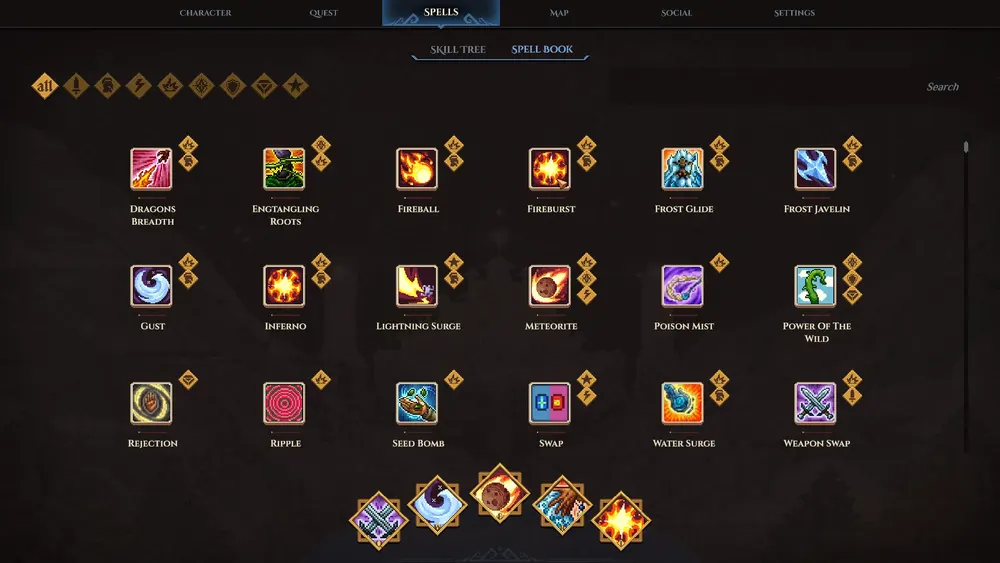
The spell collection illustrates the difference between available spells and the five active positions. It does not show a finished Human fire allocation.
Human weapons belong in the recovery plan
Human retains sword and crossbow options alongside its caster spells. Landing basic attacks restores Concentration during combat, so choose an attack position you can use reliably between casts.
Weapon Swap itself has a cost in the recorded examples. Avoid switching repeatedly without a purpose while trying to recover the resource for your next spell. Pick the useful form, land the attack and then continue the planned sequence.
If recovery seems ineffective, confirm that the ordinary attacks actually hit. A physical-damage active skill is not automatically the basic attack used by the recovery loop. The Dimraeth races guide explains why this weapon rhythm belongs to the racial kit rather than being unique to Mage.
Utility can make the fire sequence usable
The recorded Human Magician mixes fire, ice and curse-related effects. That is a reason to consider function before theme when filling the active bar. An action that creates time to cast can contribute more to the fire plan than another overlapping damage button.
Choose utility for a problem you actually encounter. If you cannot finish a cast before the enemy reaches you, inspect positioning and the opening. If you are dying while standing in an area effect, move out rather than expecting another damage modifier to solve it.
Do not call every extra effect a required part of this build. The exact non-fire loadout and complete final tree are not verified here. Use the examples to understand why a character might keep another element or support tool alongside the main Burning direction.
Equipment and pets need their actual conditions
Fire-related items in the material include resistance, triggered effects and temporary fire interactions. Those categories are not interchangeable. An item helping you survive fire damage is not automatically the best item for increasing your Burning payoff.
Some fire-themed gear appears on a Minotaur character. Finding it there does not establish a Human Mage best-in-slot list. Inspect the item's condition, required set pieces and effect before deciding whether it supports your own setup.
The same applies to pets. A pet effect may provide damage, resource support or protection, but player-assigned pet names are not reliable species names. Treat the effect shown in your current description as the useful information.
Solo and co-op timing differ
In co-op, another player may supply an effect, draw attention or create an opening. If a sequence depends on that contribution, identify it. Do not present the combined result as something the Human Mage necessarily produces alone.
Coordinate stack use when two players interact with Burning. One player consuming the effect can change the setup another player expected to use. Agree on who applies and who follows up instead of assuming two fire directions automatically reinforce each other.
For solo play, test whether you can complete the setup while maintaining your own recovery and escape options. The Dimraeth class guide compares this direction with other supported interactions.
Fire build troubleshooting
| Problem | Check first |
|---|---|
| The payoff feels inconsistent | Burning state before the consuming action |
| Casting stops after the opener | Basic-hit recovery and unnecessary Weapon Swap costs |
| Oil is unavailable when needed | Prepared item slot, item state and charges |
| A copied path does not appear | Race–class combination and prerequisites |
| Damage improved but survival worsened | Lost utility slot or a longer casting commitment |
| An effect disappeared after changing equipment | Set count and trigger conditions |
Use the Dimraeth spell-equipping guide for assignment and input problems. Getting the right icon onto the bar, selecting its intended modifier and using its input correctly come before judging the entire fire direction.