
For early Dimraeth skill points, prioritise an action you will use now, its necessary route and the support that lets you repeat it. A distant keystone may define a later build, but it does not solve an immediate problem if the required connecting points and complementary skills are still out of reach.
There is no verified universal first-ten-points route here. Race and class change the available combination, and your next useful node depends on the actions already available. Use the decision sequence below to avoid buying attractive bonuses that do not support the character you are actually playing.
Dimraeth early skill-node priorities
| Current problem | Type of node or choice to inspect | Check before buying |
|---|---|---|
| You lack a useful active action | A reachable spell in the selected tree | Prerequisites, total path cost and its role in the loadout |
| Your main action works but creates a timing problem | Its modifiers | What the chosen option replaces |
| A payoff has no setup | An application or resource-generating interaction | The generator works with the spender you intend to use |
| You keep being caught after attacking | A movement or survival option available to the combination | Whether it addresses the actual failure |
| A desired book is unusable | Attribute training or relevant attribute support | The exact book requirement, not its theme |
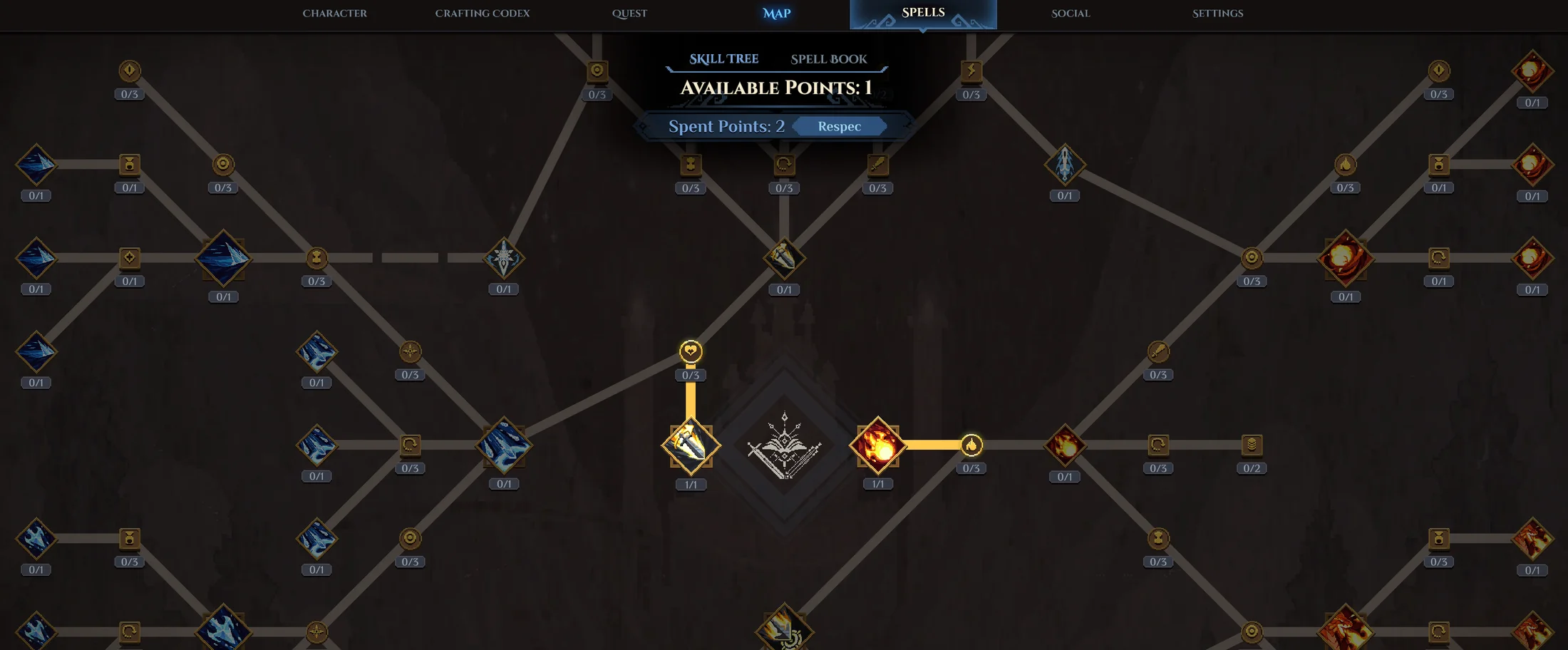
Connected nodes in the development tree. Count the route to a destination; do not mistake every visible node for an immediately available purchase.
Start with the action, then inspect its branch
Choose one action you expect to use repeatedly. Identify whether you want it to apply a status, spend a status, create space or contribute another specific job. Then inspect the branch that supports that job.
Small attribute nodes, active spells and modifiers are different kinds of investment. A connecting attribute node may be part of the route to an action rather than the final reason for taking the path. Count that cost instead of comparing only the destination icons.
Check whether the new action will earn an active slot. Dimraeth allows five equipped spells. A node granting a useful spell can still be a poor immediate purchase if you do not intend to replace any of the five actions currently doing necessary work.
The Dimraeth skill-tree explanation separates the race, class and archetype contributions. That distinction matters when a route shown for another combination is unavailable on your tree.
Preserve a movement skill's useful behaviour
Vortex provides a practical modifier lesson. The Minotaur Brawler example considers changing its form, then values retaining movement. That movement contributes to survival and positioning, so removing it changes more than the skill's damage.
Before spending on a modifier, read what behaviour disappears or changes. If the action currently gets you out of danger, identify the replacement escape tool before converting it into something less mobile.
This is not a rule to avoid damage modifiers. It is a rule to compare the full trade. If another action now handles movement reliably, the alternative modifier may make more sense for your current loadout.
Buy setup before depending on the payoff
Effect-based builds need the condition that activates their benefits. A bonus against Bleeding targets asks for a way to apply Bleeding. A skill that spends Rage asks for a generator. A Fireball modifier that consumes Burning asks for Burning stacks on the target.
Write the interaction in order before investing. If you cannot identify the setup action, the payoff may be a later purchase rather than the next point. Taking several payoffs together does not supply a missing generator.
Recheck the sequence after obtaining a new skill. In the Minotaur Bleed example, the jobs assigned to Vortex and Pulverize evolve. Copying a generator from one stage and a spender from another can produce a written build that was never actually used as a complete configuration.
Modifier choices can be exclusive
A spell can have several appealing variants without allowing every variant simultaneously. Choices may be exclusive within an aspect. Read which option is selected and what selecting another replaces.
Fireball is a useful example: charged, piercing, rapid and Burning-consuming behaviours offer different decisions. They should not be combined into an imaginary early spell with every advantage at once.
After a modifier purchase, test the new input and timing. A charged behaviour can ask for a longer safe opening. A stack-consuming behaviour can change the order of your actions. Treat the modifier as a gameplay change rather than merely a percentage increase.
Attributes, experience and book requirements
Earned experience and completed attribute training are separate stages. If your next goal is a spellbook with a requirement, check the current attribute value and the training cost before spending elsewhere.
Flaming Strike has a concrete pre-release learning example involving Memory and Adventure requirements. The point of the example is that more than one attribute can matter, not that every current version must retain those recorded numbers.
A world spellbook can fill a gap without granting every exclusive modifier from another class or archetype. Decide whether you need the book's base action or a specific tree-supported interaction. Those are different reasons to invest.
Read the Dimraeth spell-equipping guide if the book is obtained but the action is not usable. Skill-point spending will not fix a spell that simply has not been assigned to the intended slot.
Avoid building around an assumed free reset
Respec-related descriptions exist, but the current full cost and refund scope are not established here. Do not spend casually on the assumption that every point, attribute and class choice can be undone through one free operation.
That does not require perfect planning. It means making the next purchase for a reason you can describe: gaining the action, meeting its route, supporting its resource or fixing a recurring combat failure.
If you are unsure between two distant directions, test the ordinary playstyle before committing further. The Dimraeth class guide compares concrete interactions without pretending to supply an exact route for every combination.
A useful first purchase checklist
Before confirming a point, check the destination and all connecting costs, the action's role, any exclusive modifier choice and the loadout slot it would use. Then ask what changes in the next encounter.
If the answer is only that a distant build might eventually need it, compare that purchase with something that improves an action you use now. Early points are most useful when the character can put them to work immediately, while still keeping the intended later direction in view.