
Dimraeth's visible skill tree combines three contributions: race, class and archetype. Race supplies part of the basic identity, class adds another set of actions and choices, and the archetype belongs to the particular race–class pairing. The result is one character tree with shared and combination-specific elements.
This explains why two Mages can share a spell but follow different surrounding paths, and why two Humans can retain a weapon-switching identity while choosing different classes. A common spell name is not proof that the complete trees are interchangeable.
Dimraeth race, class and archetype differences
| Layer | What it describes | Example of the distinction |
|---|---|---|
| Race | The racial kit and tree contribution | Human's sword and crossbow switching appears across different Human classes |
| Class | The selected class's contribution | Mage spells can coexist with Human weapons or Elf daggers |
| Archetype | The contribution of the pairing | Minotaur Brawler has a described basic-attack-to-Blunt interaction |
| World spellbook | An additional learnable action with requirements | A character can acquire a useful spell outside its native tree |
| Equipment effect | A bonus or trigger under gear conditions | Wearing enough set pieces can produce an effect without adding a manual slot |
The last two rows are additional sources of capability, not extra layers that should be counted as race or class. Keeping them separate makes it easier to reproduce a build and diagnose what disappeared after a change.
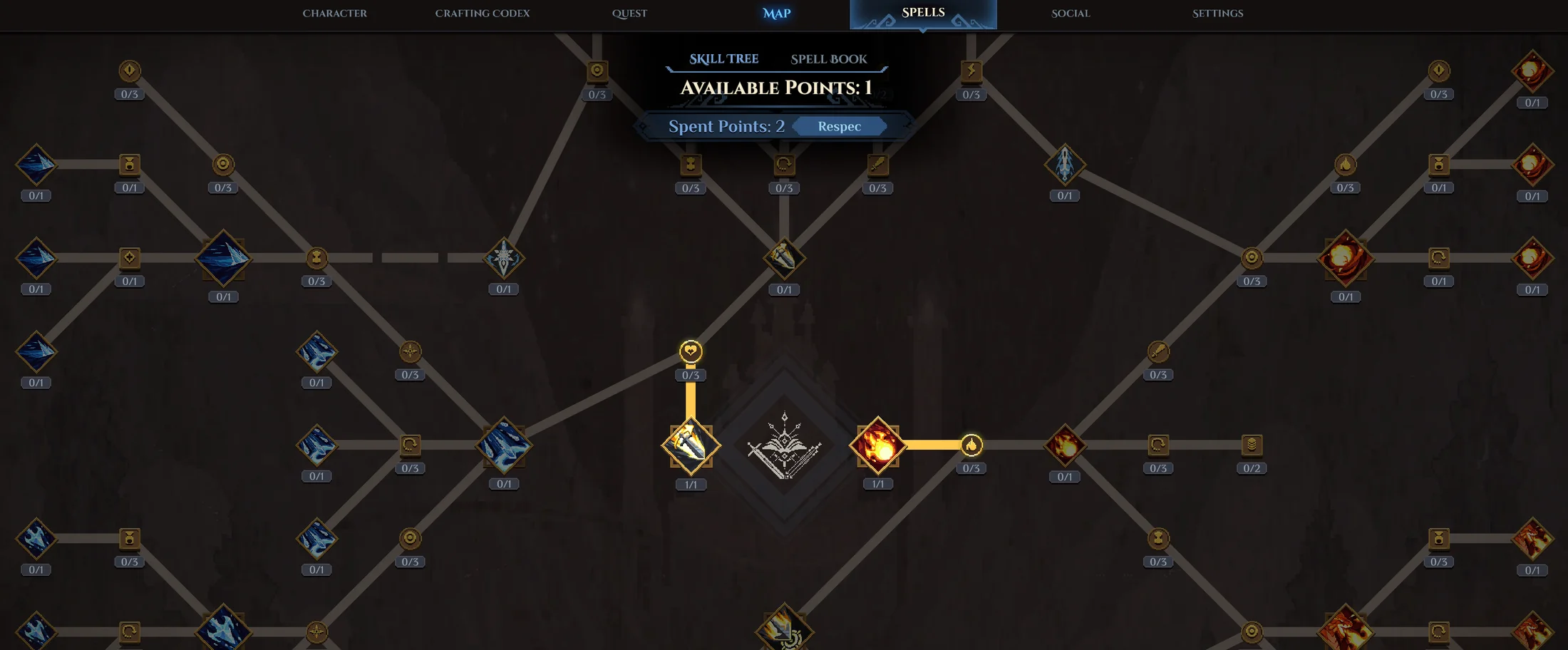
The development tree shows connected nodes and branches. The image illustrates structure, not a complete allocation or a labelled map of every current layer.
Race contributes a persistent combat identity
Human Weapon Swap is not a Shadow-only feature. It appears with Human Brawler and Human Magician as well. That is a useful example of a racial contribution continuing across class choices.
Elf Mage provides another example: the character retains daggers while using class spells such as Fireball and Blizzard. Choosing Mage does not mean the race's ordinary combat rhythm disappears.
Minotaur's deliberate melee identity likewise should not be confused with the Brawler class itself. The race can choose other classes. A new class changes the combination, but the name alone does not erase the racial starting kit.
Read the Dimraeth races guide when comparing those ordinary actions. If you are analysing a tree, first identify the character's race so that a racial spell or weapon action is not incorrectly attributed to the class.
Class contributes shared ideas without identical trees
The class choice adds another part of the character's available spells and choices. Brawler, Mage and Shadow exist across the current three races, but the resulting trees also contain the racial and archetype contributions.
Two Mage characters can therefore share Fireball while differing in basic weapons, connecting paths and supporting interactions. A modifier discussed for one combination needs to be checked on the other combination's actual tree before being copied.
The same caution applies to a broad label such as melee. Human Brawler and Minotaur Brawler do not become identical because both can fight close to an enemy. Identify the shared class element, then examine what the race and pairing add.
The Dimraeth classes guide explains the three class choices. Use the whole race–class name when recording a route so that another player knows which tree the instructions describe.
Archetype belongs to the pairing
The archetype contribution is why the selected combination matters beyond adding two independent lists. It can support interactions associated with that pairing, such as the Minotaur Brawler basic-attack conversion to Blunt damage.
That conversion should not be described as a starting passive possessed by every Minotaur or a rule shared by every Brawler. It is a specific interaction that must be reached and selected in the relevant combination.
A character's earlier guess about a node's origin is not a reliable classification. In the recorded material, the player revises their interpretation of which parts belong to race, class or the pairing. Follow the actual system distinction rather than preserving the first explanation made while exploring an unfamiliar tree.
For practical planning, write down both the combination and the interaction. “Minotaur Brawler pursuing the Blunt-conversion keystone” gives useful context. “Any Brawler stun build” loses a condition that may be essential to the route.
Tree size is not a point budget
The tree explanation describes roughly 230 race nodes, roughly 230 class nodes and roughly 80 archetype nodes, producing a combined tree of more than 500 nodes. Those are approximate descriptions of scale, not a promise that every character can purchase every visible option.
The Early Access point budget is much smaller, described at roughly 60 points around the level-25 scope. Treat that as an approximate planning boundary rather than an exact level-by-level reward formula. The material does not provide a complete ledger of every level, quest and boss point award.
A large tree therefore presents choices. The useful question is not how long it takes to fill everything, but which route supports the actions you want within the points actually available.
Count connecting nodes as well as the destination. A keystone's icon may describe the payoff, but reaching it can require investment along a path. Comparing only the final node descriptions understates the cost of a route.
Plan a reachable next step
Begin with the next action you want to improve. Find the relevant branch, inspect its prerequisites and count the investment needed from the current allocation. Then decide whether the benefit is useful immediately or belongs to a later stage.
If a distant interaction is the long-term goal, the intervening character still needs usable attacks, recovery and survival. Do not ignore those needs because the final node sounds powerful.
The Dimraeth class comparison explains how class choices affect the attacks and resource loop behind a combat sequence. A route should serve a sequence, not merely connect attractive icons.
Spells, small nodes and modifiers do different jobs
A small attribute node, an active spell and a spell modifier should not be evaluated as the same purchase. One may support requirements or connect a path; another supplies an action; another changes how that action behaves.
For an active spell, identify the job it will perform and the slot it will use. For a modifier, identify what changes and what may be replaced. For a connecting node, count its cost as part of reaching the intended destination.
This approach prevents a common planning mistake: listing several powerful endpoints without paying for the routes between them. It also prevents comparing a utility action only by damage when its actual purpose is movement or setup.
After a purchase, check the node's condition; use the spell assignment guide if its action is missing.
Modifier choices are real trade-offs
Spell modifiers can be exclusive within an aspect. Selecting a variant is therefore a choice, not necessarily another bonus stacked on top of every alternative.
Fireball illustrates several possibilities: charged, piercing, rapid and Burning-consuming behaviours. They can change the opening required, the targets affected or the position of the spell in an effect sequence. A written build must specify the selected behaviour rather than collecting every desirable description.
Vortex provides a movement example. A player considers changing its form but values retaining mobility. That decision is understandable only when the spell's escape or repositioning job is included in the comparison.
Before changing a modifier, identify the job you would lose and whether another action covers it. Then test the new timing. A nominal damage improvement can make an encounter harder if it removes the movement that made the previous sequence safe.
Status application and consumption need an order
Effects such as Burning and Bleeding can support other actions. Some interactions apply an effect, some reward its presence and some consume it. Those roles should appear in the intended sequence in a workable order.
For Burning, a setup action can prepare stacks before Combusting Fireball spends them for a payoff. Casting the consumer at a different stage changes the state left for the next action.
For a Bleed direction, identify which selected action applies the condition and which benefits from it. If a new spell replaces the only application tool, the remaining payoff may no longer work as expected.
Resource buffs deserve the same attention. A Rage spender needs a generator in the current configuration. The Minotaur example changes those responsibilities while developing, so an earlier and later description should not be merged into a configuration that was never selected together.
World books extend choices without replacing the tree
World spellbooks can be obtained through exploration, rewards, merchants and crafting services. Different combinations can learn them when their requirements are met. That broadens the action pool beyond the native tree.
Learning a world spell does not establish access to every exclusive modifier in another combination's tree. Distinguish the base action you obtained from the surrounding support that made it behave a particular way on another character.
A recipe is also not the same as the finished book. Crafting may still be required, and the book may have attribute requirements. The Dimraeth recipes guide covers acquisition through crafting; the spell-equipping guide covers learning and assignment.
If a desired skill appears in another player's loadout, ask which source supplied it. The answer might be a native node, a world book or an equipment trigger. Assuming all three are class-tree unlocks produces a misleading route.
Five active spells and equipment triggers
Only five spells can be equipped at once. The learned collection can provide more alternatives, but a growing collection does not add more manual active slots.
An equipment set may produce a triggered spell effect when its conditions are met. That effect should not be counted as a sixth manually equipped action. If it disappears after replacing gear, inspect the set count before looking for a missing tree node.
This distinction is especially important when copying a combat sequence. A guide that lists the visible effects without identifying their sources can imply that the player should assign more active spells than the loadout permits.
For every essential effect in your own plan, name its source and condition. That makes equipment changes, spell replacements and modifier decisions easier to evaluate without rediscovering the dependency after a failed fight.
Attributes and skill points are related but different
Experience is used in attribute training in the demonstrated progression. Attribute requirements can gate a book, while skill points govern tree purchases. Neither should be treated as an automatic substitute for the other.
If a book is unusable because an attribute is too low, inspect training and the displayed requirement. If a tree destination is unavailable, inspect the connecting path and points. If an action is learned but absent from the bar, inspect assignment.
Race and class can affect training costs, which is one reason to consider requirements when choosing a combination. It does not establish a complete universal cheapest route or remove the need to read the current values.
The Dimraeth character creation guide explains those starting choices. Keep the immediate goal concrete: the requirement for a book, the path to a node or the function of an active slot.
A spellbook example across the layers
A Flaming Strike recipe leads to a crafted book with learning requirements; it does not purchase a tree node. Learning and assigning that action are separate from spending skill points.
None of those steps proves that the character has changed class or acquired every fire-related branch from another archetype. If a later equipment effect supports the fire action, that is another condition to keep track of rather than another proof of class identity.
Missing ingredients, unmet attributes and an absent bar icon each belong to a different system. Rebuilding the tree will not resolve those acquisition or assignment problems.
Troubleshoot the layer that changed
| Symptom | First layer to inspect |
|---|---|
| Another Mage's path is different | Race and archetype, not just the class label |
| A new book cannot be learned | Attribute requirements and the actual item obtained |
| A spell is learned but never activates | Active assignment, binding and input behaviour |
| A former escape action became stationary | Selected modifier |
| A payoff stopped triggering after a slot change | Status or resource generator in the current loadout |
| A combat effect vanished after changing gear | Set count and equipment trigger |
| A distant node remains unavailable | Connecting route and point budget |
Check one layer at a time. Rebuilding the entire character is unnecessary if the only issue is that an action was assigned to the wrong slot. Equally, rebinding a button will not supply a missing keystone prerequisite.
A clear tree plan describes the combination, the route, the selected spell behaviour and the condition it uses. Once those pieces are explicit, you can compare alternatives by what they change in the fight rather than by the number of impressive nodes visible on the screen.
Use the Dimraeth early skill-tree node priorities to choose a useful next investment. The Human Magician fire-build guide applies these choices to Burning, recovery and utility without presenting an unverified full allocation.